Showing posts with label Book Review. Show all posts

Sunday, April 26, 2009

How We Decide, by Jonah Lehrer

For those who have read Malcolm Gladwell's Blink, this book may seem to get off to a bit of a slow start (Lehrer also refers to the same strawberry jam experiments and makes the same points regarding how the brain works). About a fifth to a third of the book sounds familiar from the start. It needs to set up the same frame work for understanding how the mind works on unconcious levels.

However, Jonah eventually starts to venture into new ground when he begins discussing moral decision making.

His highlights the key take aways of his book, the most important being to "think about thinking":
Whenever you make a decision, be aware of the kind of decision you are making and the kind of though process it requires.
Specifically:
  • Simple problems require reason.
  • Complex problems benefit (ironically) emotional decisions.
  • Novel problems require reason - analyze underlying patterns to find solutions.
  • Embrace uncertainty - deliberately contrarian hypotheses to avoid discounting uncomfortable yet material facts.
  • You know more than you know (paradoxically) - emotions may often be hard to analyze, but they can provide a wealth of information if you know how to use them and when to trust them (and what their limitations are).
  • The best decision making requires analysis and emotions and the best decision makers will have a mixed approach, knowing when to use which.

Sent from my BlackBerry device on the Rogers Wireless Network

Sunday, April 19, 2009

Jack and Suzy Welch, Winning

If I had to use only the shortest possible sentence to describe the mechanics of success so that anyone can understand Jack's management style it would be:

"Use only the shortest possible sentence
to describe the mechanics of success
so that anyone can understand."


Jack is an avid crusader against unnecessary bureaucracy and management layers in favour of flexibility and ownership as a mechanism for empowerment. The ideas he puts forth in his books expounds his philosophy that direct communication and quick action in its various forms are the key to success in a variety of different operational functions.

While hardly a new book, it is one of my favourites. Jack deals with a broad range of topics, each of which is still relevant (sadly) today. Some of my favourite topics discussed are:
  • Candor - direct and clear communication of unpleasant (but necessary) topics in the search for solutions
  • Differentiation - the acknowledgment and rewarding of good work and values and the correction of poor behaviours (a natural corollary to candor)
  • The hiring batting average - holding recruiters responsible for building an organizational culture around performance
  • Divesture and parting ways - dealing with issues of strategic and systematic non-performance in organizations and individuals
  • Six-sigma - Understanding the value of consistency. Literally in statistics: reducing the variance of output to encompass six sigmas (standard deviations) - a *very* narrow band in any field
  • Ownership in career management - taking responsibility for advancement through adding value and understanding your role
His books have strikingly similar content to his website / pod cast (nearly identical in some areas) so even if you don't have time for the book (or prefer to consumer media in a different format) I would strongly recommend you having a look.

Sent from my BlackBerry device on the Rogers Wireless Network

Monday, April 13, 2009

Kickstart - How Successful Canadians Got Started

By Alexander Herman, Paul Matthews and Andrew Feindel

Canadian talent usually tends to be understated, and these authors venture out to learn from successful Canadians and how they got their start in life. Many of us can sympathize with (or are currently experiencing) the concept of a quarter-life crisis, the idea that we have reached a point in our lives where we are re-evaluating how we want to apply ourselves and the directions we want to set.

Each personality has a different definition and vision for how they apply themselves and what they want to achieve. There are a broad range of experiences, each with its own lessons for any reader. Interestingly, one's "key to success" could become another's potential road to disaster.

I think the book's structure makes it both interesting and easily digestible. It certainly feels as if each story is like sitting down for a coffee with the interviewee. The biographies are divided into three groups: Searchers, Survivors and Dreamers, and each story reflects the Canadian perspective and highlights how our unique backgrounds can help (or impede) our path to success (whatever form it takes).

A must read for young Canadians, especially those of us about to (or who have recently) come out of university and are dealing with the quarter-life crisis. The three authors are friends of mine from high school and (as the introduction suggests) are currently facing the same challenges that we all are.

Sent from my BlackBerry device on the Rogers Wireless Network

Wednesday, April 8, 2009

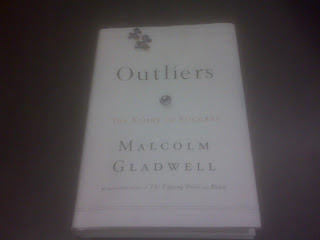
Malcolm Gladwell's Outliers

I've been looking forward to this book since Jim Balsillie hinted at WES that his old U of T college roommate and author of Blink, Malcolm Gladwell, was writing his third book (I hear he was a speaker at WES again this year).

Gladwell investigates the story of success and undermines key assumptions in the story of the successful "individual".

He talks about society's overarching design to promote talented individuals and the flawed idea that differences in underdeveloped individuals disappear over time. He contends that rather than dissipate, they actually become amplified.

He recognizes certain key factors of success:
  • Hard work - manifested as 10,000 hours cumulatively spent on learning a skill set.
  • Complexity, autonomy and a relationship between effort and reward in doing creative work as a measure of how meaningful each hour is
  • The effect of power distance and language to affect entitlement and the ability to challenge while asking the right questions
  • The benefit of persistence, self education and drive in development
Malcolm Gladwell emphasizes the role of opportunity, not just as luck nor preparedness, but a blending of the two in order to produce outliers, success stories on the long tail.

Sent from my BlackBerry device on the Rogers Wireless Network